

Dead or Alive 2 vs Dead or Alive 3: Wanted (2026): Which Is Better?
Dead or Alive 2 gave you a choice. Dead or Alive 3: Wanted gives you a system. NetEnt's cult classic and its 2026 sequel share a theme and a studio — but the mechanics, grid, and risk architecture are nothing alike. Here's the honest breakdown.
Updated
Originally published
Quick Verdict
- Verdict
- Dead or Alive 2 gave you a choice. Dead or Alive 3: Wanted gives you a system. NetEnt's cult classic and its 2026 sequel share a theme and a studio — but the mechanics, grid, and risk architecture are nothing alike. Here's the honest breakdown.

This guide is part of our Slot Guides series — covering the mechanics, math, and strategy behind modern slot design.
Best Casinos to Play These Slots
Top-rated casinos recommended for the slots covered in this guide.
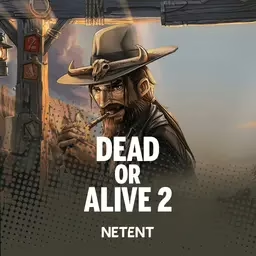
Dead or Alive 2 came out in 2019 and players are still talking about it. Dead or Alive 3: Wanted is brand new in 2026. Same NetEnt studio, same western theme, and that is about where the similarities end. The grid changed, the payline count changed, the bonus system changed, and the community reaction has been loud. If you are deciding which one to put money into, this is the breakdown.
One thing to know upfront: DOA3: Wanted has not landed well with DOA veterans. The consistent feedback from players who know the series is that it does not feel like a Dead or Alive game. We will explain why that is technically true, not just a matter of taste, as we go through each section.
Side-by-Side Stats
DOA2 has the higher max win at 111,111x and a fixed RTP of 96.8%. DOA3: Wanted sits at 66,666x max and 96.03% RTP at full value. The catch with DOA3 is that its RTP is not fixed. Depending on the casino, it can run as low as 92.08%. That range matters a lot when the top feature buy costs 1,000x your bet.

✓ marks objective advantage
How the Mechanics Actually Differ
DOA2 gives you a choice before the bonus starts. Land three or more scatters and you pick one of three Free Spins modes. Train Heist builds a progressive multiplier with each wild, awarding an extra spin every time and a bonus of five spins when you hit 16x. Old Saloon applies a flat 2x multiplier and makes wilds sticky. Fill all five reels with sticky wilds and you get extra spins. High Noon Saloon turns wilds into multiplier wilds, with 2x per reel for two wilds and 3x for three. Filling all reels gives extras. It is the most volatile mode and the one most players default to when chasing big numbers.
That pre-feature choice is a big part of why DOA2 still has a following. You commit to a strategy before anything happens. The 9-line structure concentrates wins onto fewer lines, so when something lands it registers as a proper win rather than splitting across the grid.
DOA3: Wanted drops the mode selection entirely. Instead, two wild types interact with each other during play. Wanted Wilds land with random multipliers from x2 to x100 and substitute for everything except the Bonus symbol. Bounty Hunter Wilds cover full reels and absorb the multipliers from any adjacent Wanted Wilds. When multiple Bounty Hunters land next to each other they merge, stacking their collected multipliers. In Free Spins all wilds are sticky. In Super Free Spins a Bounty Hunter Wild lands on every spin guaranteed.
The Elevate Feature is DOA3's version of a bonus buy, but with five tiers. 2x bet guarantees at least one Bonus symbol in view. 5x bet raises the Wanted Wild multiplier ceiling and doubles the max win from 33,333x to 66,666x. 100x bet triggers Free Spins directly. 150x bet puts Bounty Hunter Wilds in the base game on every spin. 1,000x bet activates Super Free Spins with a guaranteed Super Bonus symbol.
The payline jump from 9 to 21 is the mechanical point that irritates DOA fans most. A big win on 9 lines lands as one concentrated payout. The same win on 21 lines splits into smaller hits across more lines simultaneously. The total can be equivalent, but it does not feel the same. That is not a subjective complaint. It is how payline math works and it is worth knowing before you sit down with DOA3 expecting DOA2 energy.
Risk vs Reward: Feature Modes Plotted
Each bonus mode in DOA2 sits at a different point on the risk-reward curve. DOA3's Elevate tiers do the same but in a different shape entirely. This chart maps where each one actually sits.
Estimated from structural data — not provider confirmed. For illustration only.
Volatility Signature
This is where the payline difference becomes visible in the data. DOA2's 9-line structure creates a sharper win-size histogram — fewer mid-range hits, more pronounced spikes. DOA3's 21 lines spread the distribution differently. Both are insane volatility, but the shape of how they pay is genuinely distinct.
Estimated from structural data — not provider confirmed. For illustration only.
Volatility Breakdown
DOA2 hits roughly every three spins at 29.8% hit frequency, though most of those hits are scatter payouts below your bet rather than line wins. The bonus triggers around every 195 spins on average. The mode you picked before the feature determines how the big number arrives. High Noon can shift from nothing to a massive single spin. Train Heist builds more gradually.
DOA3: Wanted is drier. At 22.99% hit frequency you are getting something back roughly one in four spins, which makes the base game harder to sit through than DOA2 without buying a feature. Early real money play from the community puts regular bonus averages around 27x to 30x. When the Bounty Hunter chains work during Super Free Spins the feature is a different situation entirely. When they do not, the dry runs are harder to absorb than the equivalent in DOA2.
Volatility
How volatile is Dead or Alive 2?
SlotsOnFire's model estimates 70% of Dead or Alive 2's spins pay nothing; the vendor catalogue import puts its Free Spins at 1 in 195.
- High
- Volatility
- 70%
- Dead spin rate
- 75%
- Feature RTP share
- ~1 in 195
- Feature trigger
- Extreme
- Tail weight
- Dead/micro wins · 70% of spins
- Free Spins · 1 in 195 spins
- Extreme heavy tail · big wins are rare
- Max win state · capped at 111kx
What this means for you
70% of spins return nothing — Dead or Alive 2 is genuinely punishing between features.
75% of total RTP lives inside features (roughly 1 in 195 spins). Without the bonus you're playing a losing game.
Budget for variance: expect long dry patches. The wins cluster and are worth waiting for.
RTP 96.80%, max win 111,111x and hit rate 29.8% from the game's published stats · bonus trigger 1 in 195 from the vendor catalogue import · payout curve modelled
Volatility
How volatile is Dead or Alive 3: Wanted?
SlotsOnFire's model estimates 77% of Dead or Alive 3: Wanted's spins pay nothing; the vendor catalogue import puts its Free Spins at 1 in 219.
- High
- Volatility
- 77%
- Dead spin rate
- 75%
- Feature RTP share
- ~1 in 219
- Feature trigger
- Extreme
- Tail weight
- Dead/micro wins · 77% of spins
- Free Spins · 1 in 219 spins
- Extreme heavy tail · big wins are rare
- Max win state · capped at 67kx
What this means for you
77% of spins return nothing — Dead or Alive 3: Wanted is genuinely punishing between features.
75% of total RTP lives inside features (roughly 1 in 219 spins). Without the bonus you're playing a losing game.
Budget for variance: expect long dry patches. The wins cluster and are worth waiting for.
RTP 96.03%, max win 66,666x and hit rate 23.0% from the game's published stats · bonus trigger 1 in 219 from the vendor catalogue import · payout curve modelled
Where Does the RTP Actually Come From?
Both games are high-RTP on paper, but the source of that return is completely different. In DOA2 the RTP is fixed at 96.8% regardless of casino. In DOA3: Wanted it floats between 92.08% and 96.04% depending on which version your casino has licensed. Understanding where each game earns its RTP explains why that range matters so much in practice.
Estimated from structural data — not provider confirmed. For illustration only.
The key takeaway from this chart: DOA3's feature RTP contribution is heavily weighted toward the Bounty Hunter Wild compounding during Super Free Spins. If your casino is running the 92% model, that base is lower before you even reach the feature. The 1,000x Dead or Alive Spins buy was priced and modelled against the 96% version. Spending that on a 92% build is a meaningful mathematical deficit that variance alone will not close in a single session. Always check the active RTP in the game info panel before using any Elevate option above 100x.
Session Dynamics: 1,000-Spin Simulation
This is the most practical comparison in the article. The simulation shows what a typical 1,000-spin session looks like for each game in terms of balance trajectory, feature trigger points, and the size distribution of those triggers. DOA2's lower hit frequency but higher feature spike potential versus DOA3's drier base game and tiered Elevate options become very clear side by side.
Estimated from structural data — not provider confirmed. For illustration only.
Estimated from structural data — not provider confirmed. For illustration only.
A few things to read from this. First, the average time between significant balance events is longer in DOA3 without Elevate buys. Second, when DOA2's High Noon fires correctly the spike shape is more abrupt — a single spin event rather than a building sequence. Third, DOA3's Super Free Spins with guaranteed Bounty Hunters produces a different pattern: a slower ramp within the feature itself as multipliers accumulate rather than one moment of resolution.
Who Should Play Each One
DOA2 suits players who like making a meaningful decision before the bonus runs. The mode choice is simple but it gives you ownership of the session. High Noon for maximum variance, Old Saloon for retrigger potential, Train Heist for a more structured build. At $0.09 minimum bet it is also one of the most affordable insane volatility slots NetEnt has ever made. The player community around it is seven years deep and has real strategy behind each mode.
DOA3: Wanted is a better fit for players coming in without DOA2 as a reference point. If you find the Bounty Hunter mechanic interesting on its own terms and you are on the 96% RTP version, the Elevate system gives you genuine ways to shape a session. The 100x Hunted Spins buy is a reasonable entry for players who want guaranteed feature access without the full 1,000x commitment. When Super Free Spins run well with Bounty Hunters landing on every spin, it is a different kind of feature than anything DOA2 offers.
If you have played DOA1 or DOA2 for years and you are curious about DOA3: go in knowing it is a different game that happens to share the name. The comparisons to NLC mechanics in the community are fair. That is not necessarily bad, but it is a real shift from what the franchise was. Try both demos before spending anything.
Player fit
Player fit for Dead or Alive 2
Best fit: Value Seeker; also Max-Win Hunter, Feature Hunter.
Scores run 0–10 from the game's published stats; 5 or more counts as a fit. How player fit is scored
Player fit
Player fit for Dead or Alive 3: Wanted
Best fit: Max-Win Hunter; also Feature Hunter.
Scores run 0–10 from the game's published stats; 5 or more counts as a fit. How player fit is scored
Full Comparison Table
Slot comparison
How Dead or Alive 2 compares with Dead or Alive 3: Wanted
Of these 2 slots, Dead or Alive 2 has both the highest RTP (96.8%) and the largest max win (111,111x), per published game stats.
| Game | Links | |||
|---|---|---|---|---|
Dead or Alive 2NetEnt | 96.8%★ | High | 111,111x★ | View Dead or Alive 2 reviewPlay Demo of Dead or Alive 2 |
Dead or Alive 3: WantedNetEnt | 96.03% | High | 66,666x | View Dead or Alive 3: Wanted reviewPlay Demo of Dead or Alive 3: Wanted |
marks the best value in a column. Select a column heading to sort.
The Verdict
Choose Dead or Alive 2 if you want the higher max win, a fixed RTP of 96.8% with no variant risk, and a bonus structure that has been stress-tested by a serious player base for seven years. DOA2 is the cleaner game. Fewer moving parts, higher ceiling, and wins that land with weight on 9 lines.
Choose Dead or Alive 3: Wanted if you are not coming from the DOA franchise, you want the Elevate feature tiers to give you session control, and you have confirmed your casino is running the 96% RTP version. The Super Free Spins with guaranteed Bounty Hunters is a genuinely strong feature when it runs. Just do not walk in expecting DOA2 with a bigger grid.
The community verdict after early play is fair: DOA3: Wanted would be a well-received slot under a different name. As the third entry in a franchise with a devoted following, it has disappointed the people it was made for. That is worth factoring in if you are one of them.
If you are on the fence, play both demos. The DOA2 bonus mode screen and what follows it will tell you immediately whether that format is for you. So will watching Bounty Hunters either chain or not chain in DOA3. One will suit you. Let that decide it.
More High-Volatility NetEnt Picks
If you like this risk level, these are the newest slots scoring well for high-risk players right now:
Tags

PE and founder of SlotsOnFire.com with 15+ years in slot analysis.