Easy Play Slot Player Type: Calm Games, Simple Rules
Some slot players want big wins and complicated features. Others prefer simple games, modest bets, and fewer dramatic swings. Learn how SlotsOnFire's Easy Play PlayerFit score identifies games that match a more relaxed playing style.

Published
Quick Verdict
- Verdict
- Some slot players want big wins and complicated features. Others prefer simple games, modest bets, and fewer dramatic swings. Learn how SlotsOnFire's Easy Play PlayerFit score identifies games that match a more relaxed playing style.

This guide is part of our Slot Guides series — covering the mechanics, math, and strategy behind modern slot design.
Best Casinos to Play These Slots
Top-rated casinos recommended for the slots covered in this guide.
Not every slot session needs to be about chasing a huge payout. Sometimes you want a game that makes sense on the first spin, lets you bet a small amount, and doesn't hide every interesting moment behind a complicated bonus feature.
That's the idea behind Easy Play, one of the eight player types in our PlayerFit system. Easy Play players care more about enjoying the game than studying its mechanics. They prefer straightforward slots, manageable stakes, and fewer dramatic swings in their balance.
But a slot that looks simple is not necessarily easy on your bankroll. Some games have familiar reels and cheerful graphics while hiding extremely volatile mathematics underneath. PlayerFit looks past the artwork to identify games that better match a relaxed playing style.
Easy Play slots worth exploring
These games are selected using the Easy Play PlayerFit score rather than popularity or maximum win potential. The recommendations are generated from our slot database, so the selection can change as new games are added and existing game information is updated.
What makes a slot an Easy Play game?
PlayerFit evaluates Easy Play using four factors. Each contributes to the final score, but some matter considerably more than others.
| Scoring factor | Weight | Why it matters |
|---|---|---|
| Low volatility | 40% | Favors games with less extreme variation in their payouts. |
| Simple features | 30% | Rewards games with fewer mechanics and rules to understand. |
| Bonus frequency | 20% | Considers how frequently special features occur. |
| Low minimum bet | 10% | Favors games that allow smaller wagers. |
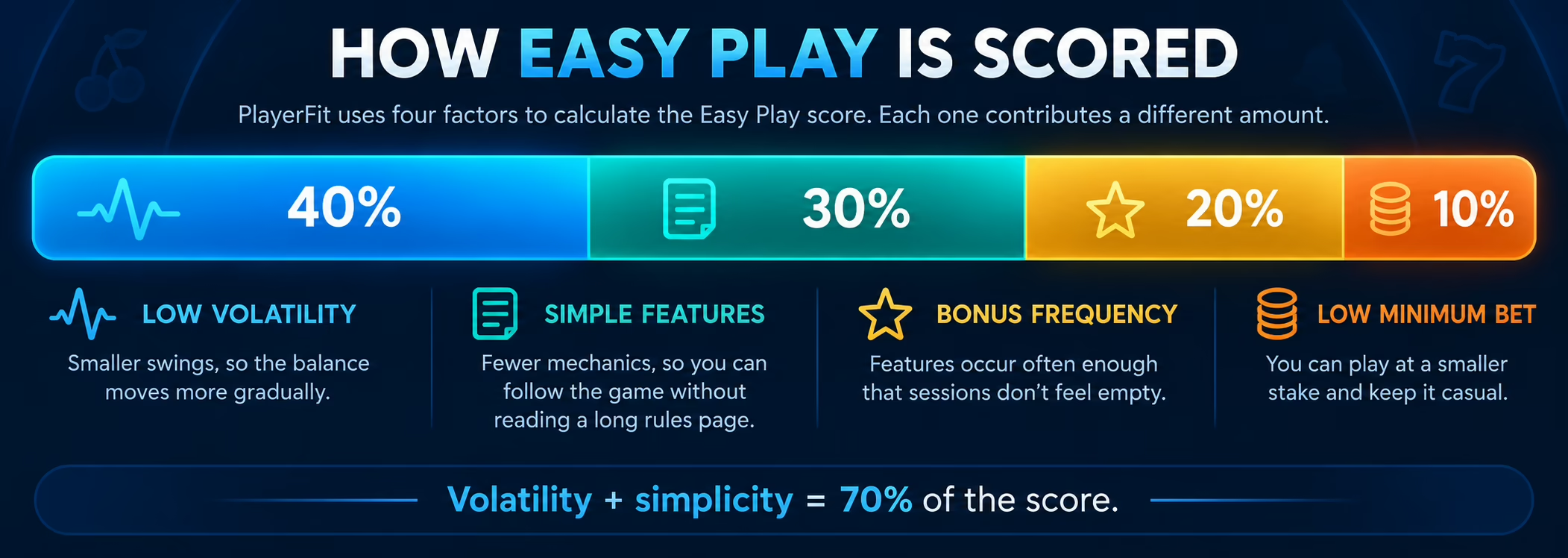
Volatility and simplicity account for 70% of the score. That tells you something important about how Easy Play works. It isn't primarily trying to find the cheapest slot or the game with the most bonus rounds. It is looking for games with a less demanding playing experience.
Why volatility carries the most weight
Volatility describes how a slot distributes its payouts. Lower volatility generally means smaller and more frequent returns. Higher volatility produces a wider range of outcomes, often with longer periods between substantial payouts.
Neither approach guarantees a particular result. A low volatility slot can still produce a losing session, and a high volatility game can pay a large amount immediately. The difference is how the game's payout mathematics are structured.
For someone who finds long losing streaks frustrating, volatility is usually more important than the artwork, reel layout, or advertised maximum win.
Why simpler features matter
A slot doesn't need five different bonus modes to be entertaining. There is something appealing about a game where you immediately understand what the symbols do and what you're waiting for.
Easy Play favors that simplicity. A familiar free spins feature or an expanding wild can provide variety without requiring you to learn several different game modes.
This doesn't mean complex games are bad. They may be excellent matches for Feature Hunters. They're simply designed around a different kind of enjoyment.
Bonus frequency and minimum bets
Bonus frequency contributes another 20%. A feature that appears occasionally can add interest to a session, while a feature that takes hundreds of spins to trigger may leave a casual player feeling that nothing much is happening.
Minimum bet receives the smallest weighting. A low starting wager makes a game accessible, but a cheap spin doesn't tell you much about how the game plays. A slot can accept a small bet and still have extreme volatility.
Theme is deliberately left to the player. A cheerful fishing game isn't automatically more relaxing than a game about ancient mythology. That's a personal preference, not a measure of volatility or gameplay complexity.
Why some simple slots cannot qualify
PlayerFit has a restriction that prevents certain games from receiving a high Easy Play score, regardless of how well they perform in other categories.
If a game belongs to the highest volatility tier, or if fewer than 10% of spins return any payout, its Easy Play score is capped at 3 out of 10.
That matters because a game could otherwise earn points for having a simple feature list and a low minimum bet while offering the opposite of the playing experience Easy Play is supposed to represent.
Imagine a slot with three reels, one bonus feature, and a 10 cent minimum bet. It looks straightforward. But if most spins produce nothing and much of the potential return depends on a rare event, its simple appearance tells you very little about how the balance might behave.
There is another safeguard. If PlayerFit doesn't have a volatility rating for a game, it doesn't calculate an Easy Play score. An empty score means there isn't enough information to evaluate the match. It doesn't mean the game received a zero.
Two games that illustrate Easy Play
1429 Uncharted Seas: simplicity with high RTP
Thunderkick's 1429 Uncharted Seas is a useful example because it combines low volatility with a relatively straightforward feature set.
The game uses five reels and 25 paylines, with expanding wilds and free spins providing the main variations on ordinary spins. There isn't an extensive collection of bonus modes to learn.
Its published 98.6% RTP also makes it interesting for players who care about theoretical return. That figure represents a 1.4% house edge over the mathematical long run, although individual sessions can finish far above or below that return.
This is where player types overlap. Someone interested in Easy Play may also identify as a Value Seeker or Steady Spinner. A game doesn't have to appeal to only one type of player.
Crazy Money: low volatility with a betting consideration
Crazy Money from Yellow Bat Gaming provides a different example. The developer publishes a 96.58% RTP and rates the game's volatility at one star out of five.
Its basic presentation is straightforward, but there is an important detail worth checking. The game's bonus mechanics are influenced by the selected bet, with higher wagers affecting access to the red Bonus symbol.
That matters for an Easy Play player who intends to stay at the minimum stake. A game can score well for simplicity and volatility without every feature being equally accessible at every betting level.
Player fit
Player fit for Crazy Money
Best fit: Steady Spinner; also Easy Play, Bankroll Player.
Scores run 0–10 from the game's published stats; 5 or more counts as a fit. How player fit is scored
The PlayerFit chart shows how Crazy Money compares across the different player types. A strong Easy Play match doesn't prevent a game from scoring differently for players who prioritize maximum wins, features, or long sessions.
Easy Play does not mean better odds
This is the most important distinction in the guide. A low volatility slot is not automatically a better value than a high volatility slot.
RTP and volatility measure different things. RTP describes the theoretical percentage of wagers returned over the long run. Volatility describes how widely individual outcomes can vary.
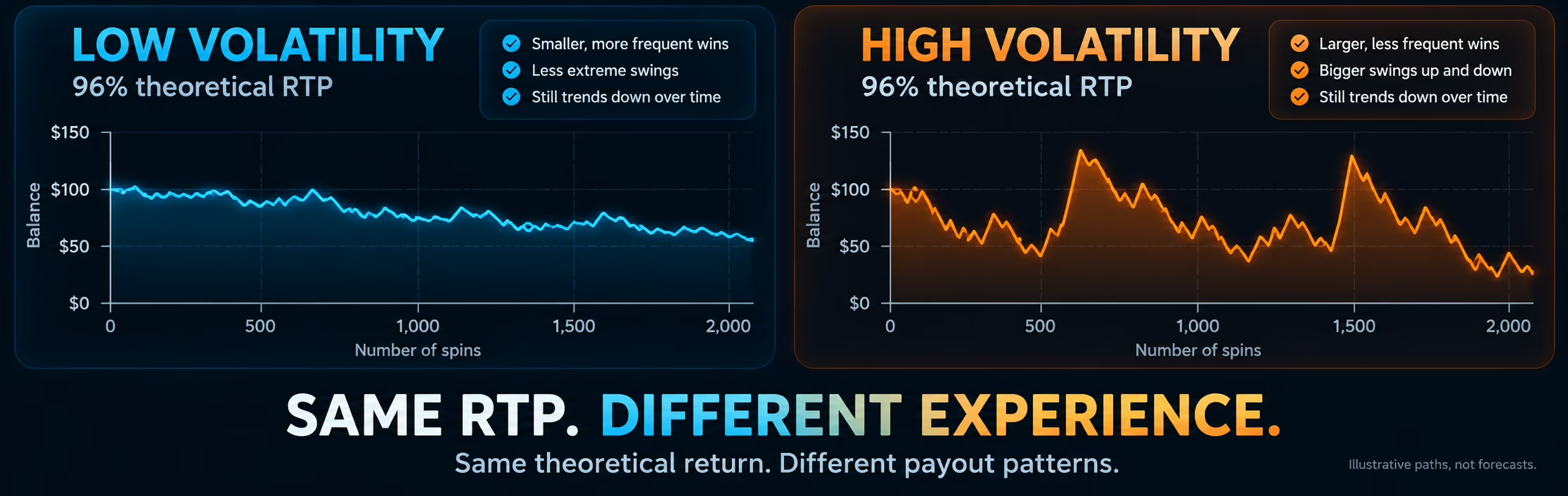
Consider two hypothetical games with the same 96% RTP. Both have a theoretical house edge of 4%. For every $100 wagered across a sufficiently large number of spins, the expected loss is $4.
The first game could distribute much of its return through smaller, more frequent payouts. The second could concentrate more of its return into occasional large wins. The expected return is the same, but the experience can be very different.
There is another detail casual players sometimes overlook. A spin that returns money isn't necessarily profitable. If you wager 20 cents and receive a 10 cent payout, the game records a paying spin, but your balance still falls by 10 cents.
That's why hit frequency, volatility, and RTP deserve separate attention. A game can produce frequent payouts while still steadily reducing your balance.
If theoretical value matters to you, compare the RTP figures alongside the Easy Play score. Also check the RTP shown inside the game, since available configurations can differ.
How to tell if Easy Play matches your style
Think about what you actually enjoy during a slot session rather than which games you tend to choose.
- You prefer understanding a game within a few spins rather than studying a long paytable.
- Smaller, more frequent payouts appeal to you more than waiting for a rare massive win.
- You enjoy bonus features but don't want complicated rules or several different bonus modes.
- You prefer modest wagers and decide how much you're comfortable spending before playing.
- Long losing streaks make the experience less enjoyable, even when a large payout remains possible.
If most of those statements sound familiar, Easy Play is probably a useful PlayerFit category for you.
You may also recognize yourself in the Bankroll Player, who pays closer attention to preserving a playing budget, or the Steady Spinner, who prioritizes extending playing time.
Those differences are worth understanding. Someone can enjoy simple games without wanting long sessions. Another player may tolerate complicated features if the game's RTP and volatility better match their preferences.
Three things to check before choosing an Easy Play slot
1. Look beyond the theme
Bright colors, friendly characters, and familiar symbols aren't reliable indicators of volatility. A game that looks gentle can still depend heavily on rare payouts.
Check the volatility rating rather than assuming the graphics tell you something about the underlying mathematics.
2. Consider the wager and playing speed
A low minimum bet doesn't guarantee a long session. The amount wagered per spin, how quickly you play, and the game's actual results all affect how much you spend.
Choose a stake that fits your entertainment budget. Lowering the stake reduces the amount risked on each spin, but it doesn't improve the house edge.
3. Try the features before committing money
A free demo can help you understand the controls, payout presentation, and bonus mechanics without risking money.
Pay attention to whether the rules are easy to follow and whether the game remains interesting outside its main bonus feature. Check whether changing the bet also changes feature availability.
Don't treat a short demo as a reliable RTP test. A few dozen or even a few hundred spins tell you very little about the game's long term mathematical return.
How to use the Easy Play score
PlayerFit scores games from 0 to 10 across the different player types. Under the current scoring rules, a score of 5 or higher indicates that a game qualifies as a match for that type.
Start with the Easy Play slots page to browse matching games. When a title catches your attention, check its individual PlayerFit scores along with its RTP, volatility, and minimum bet.
You can also explore our low volatility slots collection, compare all eight types in the PlayerFit overview, or take the 60 second player type quiz to see which categories best describe your preferences.
Easy Play is about finding games you enjoy without making the experience unnecessarily complicated. It doesn't remove the house edge or guarantee a particular outcome. Set your entertainment budget before playing and stop when you've reached it.
If gambling stops feeling like entertainment, visit our responsible gaming page for information and support.
Tags
Andrew Mueller is the founder of SlotsOnFire and holds a B.S. in Electrical Engineering (BSEE). Since 2008, he has leveraged his analytical background to deconstruct complex slot mechanics, focusing on the mathematical integrity and algorithmic logic behind RNG systems.