


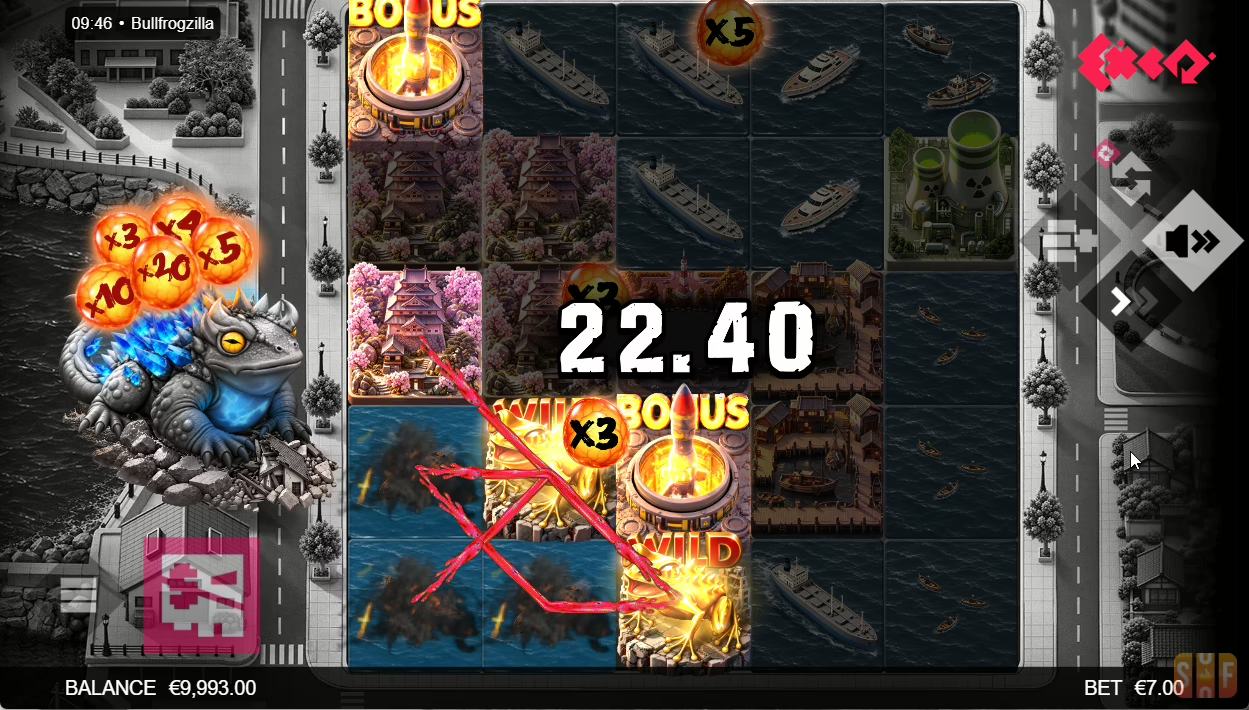
Bullfrogzilla is a 5-reel, 35‑payline slot released by EXCO in 2026. It has 95.98% RTP, Insane volatility, and a maximum win of 10,000x. According to the vendor math sheet, its signature mechanic is a Bullfrog feature that spews multiplier cells onto a 5×5 grid, which can spawn adjacent Wilds and apply additive line multipliers, with Free Spins upgrading multiplier levels and supporting persistent Jumping Wilds.
Bullfrogzilla
Click Play to Start Demo
Demo mode - No registration required
Screenshots
Slot Categories & Mechanics
This slot belongs to the following categories:
Volatility & Probability — Bullfrogzilla
Modeled from vendor-confirmed RTP, hit frequency, bonus trigger rate and max win.
Volatility
How volatile is Bullfrogzilla?
SlotsOnFire's model estimates 71% of Bullfrogzilla's spins pay nothing; the vendor math sheet puts its Free Spins at 1 in 327.
- High
- Volatility
- 71%
- Dead spin rate
- 75%
- Feature RTP share
- ~1 in 327
- Feature trigger
- Extreme
- Tail weight
- Dead/micro wins · 71% of spins
- Free Spins · 1 in 327 spins
- Extreme heavy tail · big wins are rare
- Max win state · capped at 10kx
What this means for you
71% of spins return nothing — Bullfrogzilla is genuinely punishing between features.
75% of total RTP lives inside features (roughly 1 in 327 spins). Without the bonus you're playing a losing game.
Budget for variance: expect long dry patches. The wins cluster and are worth waiting for.
RTP 95.98%, max win 10,000x and hit rate 28.9% from the game's published stats · bonus trigger 1 in 327 from the vendor math sheet · payout curve modelled
Effective RTP
Effective RTP for Bullfrogzilla by spin count
Over 100,000 spins, Bullfrogzilla's realised RTP typically lands between 86% and 106% (±1σ, modelled from its 95.98% published RTP).
Expected return stays 95.98%, but realised RTP swings widely over short sessions and only converges with volume. How we model this
| After | Expected RTP | ±1σ swing | Typical range |
|---|---|---|---|
| 5,000 spins | 95.98% | ±45 pp | 51% – 141% |
| 10,000 spins | 95.98% | ±32 pp | 64% – 128% |
| 50,000 spins | 95.98% | ±14 pp | 82% – 110% |
| 100,000 spins | 95.98% | ±10 pp | 86% – 106% |
RTP 95.98%, max win 10,000x and hit rate 28.9% from the game's published stats · per-spin variance modelled
Multiplier ceiling
Confirmed maximum multiplier: 10,000×.

Our Review of Bullfrogzilla
Overview of Bullfrogzilla
Bullfrogzilla drops a stone idol style kaiju frog into a miniature city and builds its entire math model around destructive multipliers. The 5×5, 35 line grid looks conventional at first glance, but the slot’s soul is the Bullfrog that spits Multiplier Cells and the Jumping Wilds that hoard those values across a Free Spins progression. This is built for players who enjoy Insane volatility, long setups and the chance at very large, session driven hits rather than steady line trickles.
Core Gameplay Mechanics
According to the vendor game sheet, Bullfrogzilla uses a 5×5 layout with 35 fixed paylines and standard three to five of a kind line wins paying left to right. There are regular premium and low symbols, standard Wilds, Jumping Wilds, Bonus scatters and Charge symbols that only matter in the bonus. Line evaluation is traditional. What changes the outcome of a spin is whether Multiplier Cells and Wilds intersect winning lines.
Line density is quite low relative to the 25 visible positions. You get 35 fixed lines, which means each individual line carries more weight than in a 243 ways style slot. When a line does connect with one or more Multiplier Cells, the payout jump is noticeable. That structure supports the high risk profile. Many spins will miss entirely or pay only small single line hits, while a subset of spins combine stacked symbols, Wilds and multipliers to reach meaningful returns.
In the base game, the key modifier is the Bullfrog feature. One or two Bonus symbols can trigger the frog for a single spin at a random level from 0 to 4. The frog spews Multiplier Cells onto random grid positions. Each Multiplier Cell carries a value taken from the current level’s pool. If a payline passes through that position, the multiplier applies to that line’s payout. If multiple Multiplier Cells sit on the same winning line, their values add together before the line pays. The example in the rules is 2x plus 4x giving a 6x line multiplier.
Wilds interact directly with this system. Every Multiplier Cell can generate up to eight Wilds in neighbouring positions horizontally, vertically or diagonally. This happens both in the base game Bullfrog feature and in Free Spins, where the frog acts on every spin. Wilds do not appear on the multiplier cell itself, so you are looking for patterns where multiplier positions and Wilds line up with premiums on key lines. All ordinary Multiplier Cells and the extra Wilds they generate reset after the spin in which they appear.
During normal gameplay, without Free Spins, you will see two very different states. Standard spins without Bonus symbols play like a high volatility 35 line slot with a few Wilds and occasional solid line hits. Spins that trigger the Bullfrog feature overlay the existing symbols with multipliers and Wilds, which can completely change the outcome of the spin even if the underlying symbol layout is modest. That sharp distinction between ordinary and Bullfrog spins is a big part of how the game feels in practice.
Feature Breakdown
- Free Spins: Three, four or five Bonus symbols landing anywhere award 10, 15 or 20 Free Spins. During the bonus, the Bullfrog acts on every spin, Multiplier Cells appear each round, and Charge collection and Jumping Wild progression are active for the full feature.
- Wild: Standard Wild symbols substitute for regular paying symbols and can also be spawned in clusters around Multiplier Cells. They have their own paytable line values matching the top premium symbol.
- Sticky Wilds: Jumping Wilds that appear in Free Spins remain on the grid for the entire bonus, moving one cell between spins instead of disappearing, which lets them keep collecting multiplier values.
- Multiplier Wilds: When a Multiplier Cell lands on the same position as a Jumping Wild, its value is added to the Wild’s carried multiplier. The Wild then applies that accumulated value to any winning lines it completes.
- Scatter: Bonus symbols act as scatters. One or two in the base game trigger the one spin Bullfrog feature, while three or more trigger Free Spins regardless of exact reel position.
- Bonus Symbols: These symbols define Free Spins entry tiers, interact with Hacks for pre start upgrades and are the key to accessing the stronger Bullfrog stages more often.
- Money Symbols: Multiplier Cells act as overlay money style symbols that sit on top of positions with values from 2x up to 50x depending on Bullfrog level. They apply additive line multipliers whenever a winning line passes through them.
- Bonus Game: The main bonus game is the Free Spins feature, where Multiplier Cells are guaranteed each spin, Bullfrog levels can be upgraded and Jumping Wilds persist and grow.
- Ante Bet: An optional bet state that keeps RTP at 95.98% in the 96% profile but roughly triples the Free Spins trigger rate, making the game more bonus focused without changing feature payouts.
- Buy Feature: Four EXCO Hacks allow players to buy immediate entry into the bonus at 80x, 200x, 500x or 1,000x bet, with different starting spin counts and booster setups.
- Collect Feature: Charge symbols collected during Free Spins upgrade the Bullfrog level every four Charges, award extra spins and push the Multiplier Cell pool into higher value ranges.
- Game Progression: Within a single Free Spins session, both Bullfrog level and Jumping Wild multipliers persist across spins, creating a layered progression that can build toward very high potential late in the feature.
- Autoplay: Batch Run autoplay lets players preselect a number of spins and run them without full animations, with stakes deducted per spin and full access to round replays.
Bullfrog feature, Multiplier Cells and Wild interactions
The Bullfrog feature is the defining mechanic in Bullfrogzilla. In the base game, landing one or two Bonus symbols triggers a one spin Bullfrog attack at a random level between 0 and 4. Higher levels mean richer multiplier values. According to the vendor table, Level 0 uses 2x, 3x, 4x, 5x and 10x, while Level 4 uses 10x, 20x, 30x, 40x and 50x. For that single spin, the frog spews a set of Multiplier Cells onto random positions on the grid.
Each Multiplier Cell carries one of the level dependent values and can spawn up to eight neighbouring Wilds. The important detail is that multipliers are line based, not global. A multiplier only counts if a winning payline passes through that exact cell. If a line passes through two or more cells, the values add. So a line that crosses 10x and 20x at Level 4 becomes a 30x line multiplier. Different lines can see different combinations and therefore different multipliers in the same spin.
This creates a layered outcome. First you need a paying combination on at least one of the 35 lines. Then you need that line to intersect one or more Multiplier Cells. Then, ideally, you want the cell cluster to spawn Wilds that help connect or extend that line. The additive behaviour of multipliers means that closely grouped cells can create very high multipliers on individual lines, especially in the higher Bullfrog levels. Because all ordinary Multiplier Cells and Wilds vanish between spins, this is a very spiky modifier. It can produce large single spin outcomes, but it also misses fairly often.
Free Spins, Charge collection and Jumping Wild progression
Free Spins take the Bullfrog concept and stretch it over a session. Three, four or five Bonus symbols award 10, 15 or 20 Free Spins. According to the paytable, Free Spins can also be upgraded to higher tiers via a Bonus Upgrade mechanic prior to starting, particularly when entering through Hacks, although upgrades are not guaranteed.
During Free Spins, the Bullfrog activates every spin. That means Multiplier Cells are always present, and the game adds two long term progress systems on top. The first is Charge collection and Bullfrog leveling. Charge symbols that land during the bonus are added to a collector that persists for the whole feature. Every four Charges powers up the helicopters, upgrades the Bullfrog by one level and awards +3 extra spins, up to a maximum of 16 Charges and Level 4.
Each level shift changes the Multiplier Cell value pool from the next spin. Level 0 uses 2x to 10x values, Level 1 introduces 20x, Level 2 adds 30x, and by Level 4 the pool is 10x, 20x, 30x, 40x and 50x. You are not guaranteed to reach the top level in any given bonus. That depends on how often Charges land. The progression is meaningful though, because each upgrade both extends the feature and increases the average value of any Multiplier Cells that appear.
The second progression system is the Jumping Wilds. These special Wilds can appear during Free Spins or be granted as boosters before the feature starts in some Hacks. A Jumping Wild is persistent for the entire bonus. Between spins it attempts to move one cell in any direction. On its own it behaves like a sticky Wild that roams the grid and helps form lines.
The interaction with Multiplier Cells is where the volatility spikes. Whenever a new Multiplier Cell lands on the exact position occupied by a Jumping Wild, the cell’s value is added to the Wild’s carried multiplier. The Wild starts at zero. If it collects a 4x then a 10x on later spins, it becomes a 14x Multiplier Wild. That value persists with the Wild as it continues to jump, and there is no separate upper limit on the Wild’s multiplier. The only cap is the overall 10,000x win limit on the round.
Because Jumping Wilds do not reset their multipliers between spins, a long Free Spins session where you have one or more Wilds on the grid and reach higher Bullfrog levels can create very high carried multipliers. The Wilds do not leave multiplier trails and do not spawn additional Wilds themselves. They simply carry a growing multiplier that applies on any line they help complete. This structure explains why the average bonus win is around 80x bet while the top end is far higher. Most features will not combine long duration, high levels and well placed Jumping Wilds, but when they do, the math allows explosive outcomes.
EXCO Hacks and Ante Bet options
Bullfrogzilla uses EXCO’s Hack system as a structured bonus buy suite. According to the game sheet, there are four Hacks. Hack 1 costs 80x bet and gives a 3 Bonus symbol entry with 10 Free Spins, subject to any eligible pre start upgrade. Hack 2 costs 200x bet and simulates a 4 Bonus symbol entry with 15 spins, again with possible upgrade. Hack 3 is priced at 500x and enters directly at the 5 Bonus symbol tier with 20 spins and no upgrade. The Super Hack costs 1,000x and grants 20 Free Spins with two or three different boosters applied before the first spin.
Boosters include Additional Jumping Wilds, which place one to three Jumping Wilds on the grid before the bonus starts, Additional Charge Levels, which start the Bullfrog one to three levels higher without extra spins, and Increased Charge Probability, which improves the chance of Charges landing during the feature. The Super Hack always provides two or three distinct boosters, with a 55 percent chance of two and 45 percent of three, and never repeats a type.
From a math perspective, the Hacks are not shortcuts to a higher RTP. In the 96 percent profile, Hack RTPs sit between 95.97 percent and 96.00 percent, essentially matching the main game. What they do is let you choose your variance profile. Lower priced Hacks give shorter features with more variance in starting state. The 1,000x Super Hack concentrates a lot of risk into a single high powered session, with multiple boosters making it easier to reach high Bullfrog levels and big Jumping Wild multipliers, but still capped at 10,000x.
The Ante Bet is a different lever. According to the Ante Bet table, toggling it keeps RTP at 95.98 percent in the 96 percent profile but triples the Free Spins trigger rate from 0.306 percent to 0.918 percent. Hit frequency rises slightly from 28.95 percent to 29.30 percent. You pay for this by staking more each spin in the Ante mode, but the underlying paytable and feature payouts are unchanged. It is a way to see more bonuses over the same number of spins if you accept the higher cost per round.
What makes Bullfrogzilla’s design distinctive
Several EXCO titles use Hacks, but Bullfrogzilla stands out because its entire bonus game is built around two persistent progress tracks that interact with line based multipliers. The Bullfrog level progression changes the distribution of Multiplier Cell values over time, while Jumping Wilds convert those values into a portable, accumulating multiplier that can ride across the grid.
This is a different flavour of progression from common collect features that simply unlock extra symbols or retriggers. Here, every Charge collection both extends the feature and increases the average multiplier value, and every coincidence of a Multiplier Cell with a Jumping Wild permanently raises that Wild’s power. The result is that the early part of a bonus often feels like setup, with modest returns, while later spins at higher levels can swing the total result dramatically.
The other distinctive choice is the way the base game uses the same Bullfrog engine in a one spin format. One or two Bonus symbols do not feel like wasted near misses. They are tickets to a single high impact spin with random level multipliers. That keeps the core mechanic present outside of Free Spins without relying on frequent full bonuses, which fits the Insane volatility profile while still giving the base game some teeth.
Graphics and Theme
Visually, Bullfrogzilla leans into vintage monster cinema. The bullfrog is carved stone with glowing sacs, animated with slightly jerky, stop motion style movement. The base game city is rendered as a miniature diorama with deliberate depth of field and a tilt shift look, keeping the background desaturated so that multipliers, Wilds and special symbols read clearly.
Free Spins shift to a wrecked version of the city, with fires, smoke and more dramatic lighting. Charge collection is tied to helicopter chargers that flash when the frog levels up, reinforcing the upgrade moments. The interface keeps the 5×5 grid central with Hack, Ante and Batch Run controls arranged around it. It is visually busy during Bullfrog spins, but the overlay style multipliers and Wilds are clear enough that you can see where the big lines are forming.
Engineering Techy Notes
RTP structure and partitioning
According to the vendor math sheet, Bullfrogzilla runs two profiles, 96 percent and 94 percent, with the 96 percent profile giving 95.98 percent RTP for both Normal Game and Ante Bet. Hacks sit between 95.97 percent and 96.00 percent. That tight clustering suggests EXCO tuned Hacks as access tools rather than separate, more generous modes.
We do not have an explicit RTP breakdown between base game and features, but the reference metrics are informative. Hit frequency in the Normal Game is 28.95 percent, while Free Spins trigger at 0.306 percent of spins, or about 1 in 326.83 spins. Average naturally triggered Free Spins pay 80.04x bet. Multiplying that average feature win by the trigger rate yields an estimated 0.306 percent times 80.04, which is roughly 24.5 percent of total bet returned through Free Spins in the long run.
If the total RTP is 95.98 percent and around 24.5 percent is carried by Free Spins, then the remaining 71.5 percent must be handled by base game outcomes, including Bullfrog one spin features triggered by 1–2 Bonus symbols. That is a rough partition but consistent with a high volatility game that still needs the base game to carry most of the volume.
Variance profile and sources of swing
The standard deviation of 8.26 in the 96 percent profile is high for a 35 line slot. That figure reflects both the 10,000x cap and the way progression systems stack multiplicative effects. There are three main variance drivers. First, the presence or absence of Bullfrog features in the base game. These are one spin events that can jump returns from near zero to several hundred times bet if multiple multipliers and Wilds connect with stacked premiums.
Second, the length and level depth of Free Spins. Because every four Charges both adds +3 spins and upgrades the Bullfrog level, a feature that stalls at Level 0 or 1 will deliver closer to the 80x average, while a feature that reaches Level 3 or 4 with multiple Jumping Wilds can go far beyond it. The distribution of feature length is therefore quite wide.
Third, the Jumping Wild multiplier accumulation itself. There is no explicit cap on the multiplier value a Jumping Wild can carry, only the 10,000x round cap. That means a long feature with high level Multiplier Cells landing repeatedly on the same Wild can produce very large line multipliers. Since these outcomes are rare but large, they push variance up significantly.
Line density and effective hit rate
The 5×5 grid with 35 lines creates a moderate line density. You have fewer lines than a typical 5×4, 40 line game, and far fewer win paths than any 243 ways title, which concentrates value into each line. The raw hit frequency of 28.95 percent counts any win, including small line pays that do not cover the stake.
Given the presence of 1x style low line hits and the fact that multipliers are not guaranteed, the effective hit rate of wins that are at least 1x total bet will be lower than 28.95 percent. EXCO does not publish that figure, but for a 5 out of 5 volatility game with additive multipliers, it is reasonable to expect that many winning spins will still return less than the stake, with the game leaning on occasional multi line or multiplier boosted hits to balance the books.
Feature frequency and bankroll planning
Free Spins are mathematically rare in Normal Game. The 0.306 percent trigger rate translates to an average of 326.83 spins per feature. That is a long interval, and the distribution is wide. You can easily see 600 or more spins between bonuses, or cluster two features in 100 spins. The Ante Bet improves the rate to 0.918 percent, or 108.91 spins on average, but at a higher cost per spin.
From a bankroll perspective, for standard stake play without Hacks, a sensible guideline is at least 300 bets if you want a reasonable chance of seeing multiple features and experiencing the progression systems. That aligns with the average spins to bonus in Normal Game. If you plan to use Ante Bet heavily, you are effectively paying more per spin, so you should think in terms of cash budget rather than spin count. For example, at 1 unit base stake with Ante Bet raising the cost, your 300 unit bankroll will stretch over fewer physical spins but similar expected bonus exposure.
Hacks compress variance into fewer spins. Buying Hack 1 at 80x bet means you are staking the equivalent of 80 normal spins for one feature with a 10 spin starting length. Given the average natural feature win of 80x, Hack 1’s 95.97 percent RTP is consistent with a distribution where many bought bonuses return less than the 80x cost and a minority return several hundred times bet. Super Hack at 1,000x bet is even more polarized. It has the same 96 percent RTP but concentrates a huge amount of risk into one 20 spin feature with boosters. That is mathematically similar to firing 1,000 base spins and hoping to hit one or two exceptional bonuses, but in a much shorter time frame.
Comparison to other high volatility benchmarks
Compared with benchmark high volatility titles like Dead or Alive 2 and San Quentin, Bullfrogzilla’s math is top heavy but more structured. Dead or Alive 2 relies on extremely rare sticky Wild centric super bonuses for its highest outcomes, while the base game is very flat. Bullfrogzilla instead uses additive line multipliers and a two track progression inside every bonus. This tends to produce a wider range of mid to high tier wins rather than placing almost all extreme value into a tiny subset of super bonuses.
San Quentin uses complex symbol splitting and multiplying Wilds to reach enormous theoretical caps. Bullfrogzilla’s cap is a contained 10,000x, but its Jumping Wild accumulation and Level 4 Multiplier Cells allow it to approach that cap in a more incremental way. You do not need a single perfect spin. You need a feature that lasts long enough and collects enough Charges and multipliers on Jumping Wilds. That difference matters if you are evaluating how often four figure multiples of bet are realistically reachable.
Who the math model suits
The Insane volatility, long average bonus interval and 10,000x cap make Bullfrogzilla best suited to players who are comfortable with significant downswings in pursuit of occasional large spikes. The presence of Ante Bet and Hacks gives some control over how you experience that variance. You can grind the base game and let the math play out over many spins, or you can concentrate exposure into bought features with known costs.
From a technical standpoint, the RTP is fair relative to current industry standards for high volatility games, although not generous. The 95.98 percent main profile is in line with many modern slots. What you are paying for here is not a high long term edge but an elaborate multiplier engine and progression system that can, on rare occasions, combine into very large wins.
Bankroll Guidance for Bullfrogzilla
The Insane volatility and roughly 1‑in‑327 natural bonus rate mean a bankroll of about 300 bets helps absorb dry stretches and reach several Free Spins cycles.
Source: vendor math sheet: Free Spins frequency 0.306% (1 in 326.83 spins)
According to the vendor game sheet, Hack RTPs cluster around the main 95.98% profile, so Hacks are convenience tools for volatility targeting rather than positive‑EV shortcuts.
How Bullfrogzilla Compares
Benchmarks against similar slots from the SlotsOnFire catalog.
| vs. | RTP Delta | Mathematical Note |
|---|---|---|
| San Quentin | -0.05 pp | With 95.98% RTP, Bullfrogzilla sits in the same RTP band as San Quentin’s typical 96.03% setting, yet Bullfrogzilla channels more of its risk into additive line multipliers and Hacks rather than ultra-rare super bonuses. |
✓ Pros
- •Highly interactive multiplier system with additive Multiplier Cells and persistent Jumping Wilds
- •Two layered progression tracks in Free Spins create meaningful session to session variety
- •Flexible EXCO Hacks and Ante Bet let players tune feature frequency and variance exposure
- •Base game Bullfrog feature keeps core mechanics present even without full bonuses
✗ Cons
- •Insane volatility and roughly 1 in 327 natural bonus rate can produce long dry stretches
- •RTP around 95.98 percent is average rather than generous for a high risk slot
- •Complex interactions between levels, multipliers and Hacks may overwhelm casual players
- •Hacks concentrate large amounts of risk into single features, which can be punishing on bad runs
Bottom Line
Bullfrogzilla is a focused experiment in line based multipliers and persistent progression. The combination of Bullfrog levels, additive Multiplier Cells and Jumping Wild accumulation gives the game a distinct identity and explains why it can produce very large wins when everything aligns. The base game is streaky but supported by frequent one spin Bullfrog attacks, while the bonus can swing from modest 80x range outcomes to rare, much larger sessions if Charges and multipliers cooperate.
The math is unforgiving. An Insane volatility rating, long natural bonus interval and average RTP mean this is not a slot for players looking for steady small hits or simple gameplay. For those who enjoy watching a bonus build over time, tracking levels and Wild multipliers and having access to structured Hacks and Ante Bet options, Bullfrogzilla offers a mechanically coherent and distinctive package that rewards patience and tolerance for variance.
Andrew
Engineer, Slots Player, Family Man
Reviewed on October 30, 2026
Slot Details
| Provider | EXCO |
| Release Date | Oct 2026 |
| RTP | 95.98% |
| RTP Range | 94% - 96% |
| Volatility | High |
| Max Win | 10,000x |
| Reels | 5 |
| Rows | 5 |
| Paylines | 35 |
| Hit Frequency | 28.95% |
| Min Bet | $0.1 |
| Max Bet | $100 |
| Theme | |
| Features |
Won Big on Bullfrogzilla?
Share it with the community!
Upload a screenshot and join FIRESocial
Frequently Asked Questions
What is the RTP of Bullfrogzilla?
According to the vendor math sheet, Bullfrogzilla runs on a 96% profile where the Normal Game and Ante Bet both sit at 95.98% RTP, with Hacks ranging from 95.97% to 96.00%, and an alternative 94% profile for some markets.
How often does the Free Spins bonus trigger in Bullfrogzilla?
According to the vendor game sheet, in the 96% profile the Free Spins feature triggers on average at 0.306% of spins, or roughly once every 326.83 spins in Normal Game, while Ante Bet improves this to 0.918% or about 1 in 108.91 spins.
What is the maximum win in Bullfrogzilla?
The official rules confirm that Bullfrogzilla has a maximum win cap of 10,000x the base bet per round, regardless of how high Jumping Wild multipliers climb or how many Multiplier Cells land on the grid.
Does Bullfrogzilla have a bonus buy or Hacks feature?
According to the vendor game sheet, Bullfrogzilla offers four EXCO Hacks that act as bonus buys, priced at 80x, 200x, 500x and 1,000x bet, which grant different Free Spins entry tiers and, for the Super Hack, multiple boosters.
How volatile is Bullfrogzilla compared to typical online slots?
According to the vendor math sheet, Bullfrogzilla is rated 5 out of 5 on the volatility scale, which places it in the Insane volatility bracket, with a standard deviation of 8.26 in the 96% profile and an average natural bonus win of about 80x bet.
Is Bullfrogzilla mobile-friendly?
Yes, Bullfrogzilla by EXCO is fully optimized for mobile devices and can be played on smartphones and tablets.
What mechanics does Bullfrogzilla use?
Bullfrogzilla features Free Spins along with Wild, Sticky Wilds, Multiplier Wilds, Scatter, Bonus Symbols, Money Symbols, Bonus Game, Ante Bet, Buy Feature, Collect Feature, Game Progression, Autoplay, Multiplier Cells.
Andrew Mueller is the founder of SlotsOnFire and holds a B.S. in Electrical Engineering (BSEE). Since 2008, he has leveraged his analytical background to deconstruct complex slot mechanics, focusing on the mathematical integrity and algorithmic logic behind RNG systems.
Learn More About These Mechanics
Understand the math behind the features:
This page was last updated on . Information is accurate as of the update date.