


Ministry of Like is a 5-reel Ways slot with a 5×5 grid plus a 1×3 top row, released by EXCO in 2026. It has 96.14% RTP in the default mode, Very High volatility, and a maximum win of 25,000× stake. According to the vendor math sheet, three Traffic Jam multipliers above reels 2–4 double whenever they participate in a win, while Free Spins are triggered by 3–6 Scatter bonus symbols with hack-style tiers.
Ministry of Like
Click Play to Start Demo
Demo mode - No registration required
Screenshots
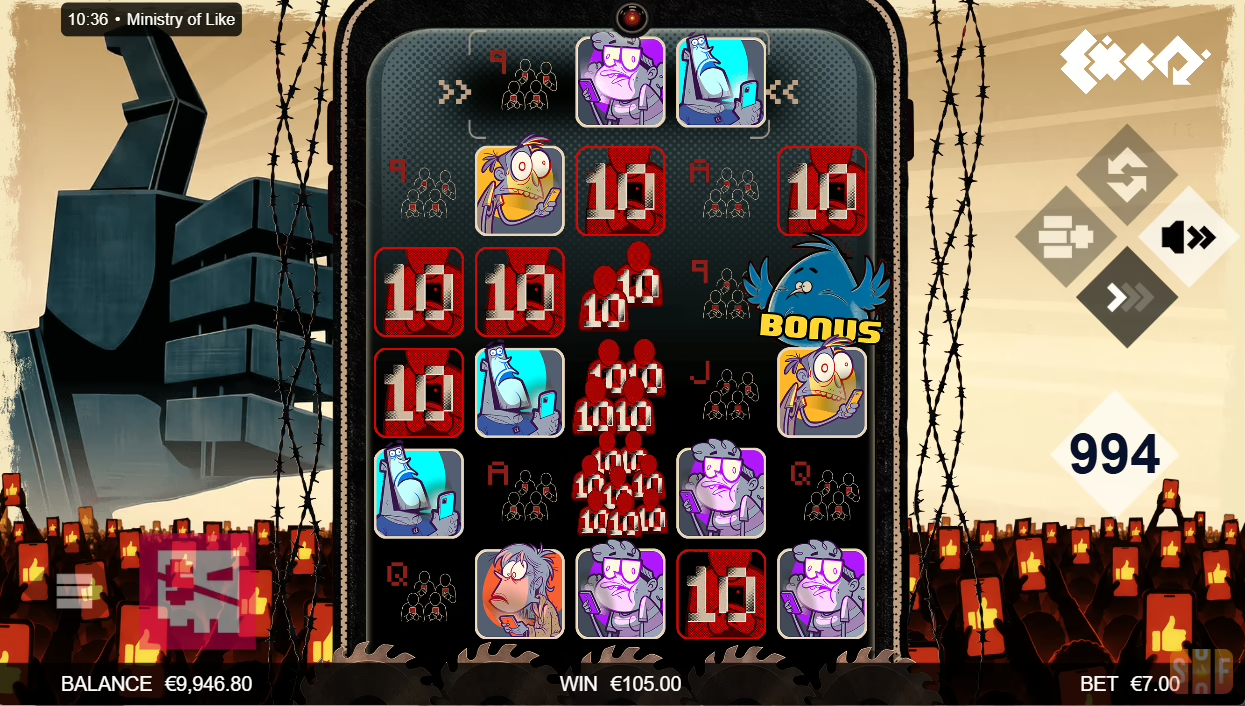
Slot Categories & Mechanics
This slot belongs to the following categories:
Volatility & Probability — Ministry of Like
Modeled from vendor-confirmed RTP, hit frequency, bonus trigger rate and max win.
Volatility
How volatile is Ministry of Like?
SlotsOnFire's model estimates 57% of Ministry of Like's spins pay nothing; the vendor math sheet puts its Free Spins at 1 in 214.
- High
- Volatility
- 57%
- Dead spin rate
- 75%
- Feature RTP share
- ~1 in 214
- Feature trigger
- Extreme
- Tail weight
- Dead/micro wins · 57% of spins
- Free Spins · 1 in 214 spins
- Extreme heavy tail · big wins are rare
- Max win state · capped at 25kx
What this means for you
Well over half of spins (57%) return nothing. Between bonuses, Ministry of Like plays like a slow drain.
75% of total RTP lives inside features (roughly 1 in 214 spins). Without the bonus you're playing a losing game.
Budget for variance: expect long dry patches. The wins cluster and are worth waiting for.
RTP 96.14%, max win 25,000x and hit rate 42.8% from the game's published stats · bonus trigger 1 in 214 from the vendor math sheet · payout curve modelled
Effective RTP
Effective RTP for Ministry of Like by spin count
Over 100,000 spins, Ministry of Like's realised RTP typically lands between 83% and 109% (±1σ, modelled from its 96.14% published RTP).
Expected return stays 96.14%, but realised RTP swings widely over short sessions and only converges with volume. How we model this
| After | Expected RTP | ±1σ swing | Typical range |
|---|---|---|---|
| 5,000 spins | 96.14% | ±60 pp | 36% – 156% |
| 10,000 spins | 96.14% | ±42 pp | 54% – 138% |
| 50,000 spins | 96.14% | ±19 pp | 77% – 115% |
| 100,000 spins | 96.14% | ±13 pp | 83% – 109% |
RTP 96.14%, max win 25,000x and hit rate 42.8% from the game's published stats · per-spin variance modelled
Multiplier ceiling
Confirmed maximum multiplier: 8×.

Our Review of Ministry of Like
Overview of Ministry of Like
Ministry of Like drops you into a social media dystopia where a 5×5 Ways grid sits under a 1×3 notification bar that controls attention and multipliers. The central idea is simple but sharp. Top row Traffic Jam multipliers double whenever they help a win, while Like symbols inject direct cash and the Ministry Feature physically rewrites the grid. This is a slot for volatility tolerant players who enjoy engineered, feature driven rounds rather than gentle line grinding.
Core Gameplay Mechanics
The core layout is a 5×5 main grid with a separate 1×3 top row above reels 2 to 4. Wins use a Ways system. matching symbols pay on three, four or five consecutive reels from the left, with any number of symbols per reel contributing to the Ways count. The top row and any expanded cells created by the Ministry Feature also count as valid positions for Ways calculations.
Line density is high because each reel can hold multiple winning positions and the game pays Ways instead of fixed paylines. That means most winning screens create several overlapping combinations, especially once the Ministry Feature has expanded reels. Individual Ways often pay modest amounts, but the real force comes from multiplying them through Traffic Jam multipliers in the notification bar.
Wilds substitute for all regular paying symbols both on the main grid and in the top row. When a Wild occupies a top row cell it behaves like any other Traffic Jam symbol, carrying an entry multiplier and doubling that value whenever it is used in a win. This makes Wilds in the notification bar especially valuable, because they both connect more often and grow their multiplier faster.
After any win, Ministry of Like uses cascading reels. Winning symbols disappear, the remaining main grid symbols drop down, and the top row slides left. New symbols fall in from above and from the right. Cascades continue as long as there is either a Ways win or a Like Injection payout on the new screen. Expanded reels created by the Ministry Feature reset back to their default height once the current round of cascades ends.
Two random mechanics can interrupt the flow. Like Injection adds value bearing Like symbols that can split into multiple copies and pay instant cash. The Ministry Feature expands or constructs symbol groups to create or extend Ways wins. The rules explicitly state that Like Injection and the Ministry Feature cannot occur on the same drop, though they can both appear in different cascades of a single paid spin.
Feature Breakdown
- Ways: A Ways system pays for matching symbols on three to five consecutive reels starting from reel 1, counting all contributing positions on the main grid, expanded cells, and the top row notification bar.
- Cascading Reels: After any win or Like payout, all involved symbols are removed, main grid symbols fall, the top row shifts left, and new symbols drop in, continuing until no further wins or Like awards appear.
- Wild: Wild symbols substitute for all regular paying symbols and can land both in the main grid and in the top row, where they also carry and double Traffic Jam multipliers when used in wins.
- Scatter: Bonus symbols act as Scatters. 3, 4 or 5 in view award 5, 7 or 9 Free Spins, while 6 Scatters trigger a 9 spin Super Hack tier directly.
- Free Spins: A multi tier bonus mode where top row multipliers persist between spins, a Like Injection or Ministry Feature is guaranteed on each spin, and retriggers add 3 to 5 extra spins depending on Scatter count.
- Hack 1: A paid entry option that buys 3 Scatter level Free Spins for 80× bet, with a chance to upgrade once to the Hack 2 tier.
- Hack 2: A paid entry option that buys 4 Scatter level Free Spins for 120× bet, with a chance to upgrade once to Hack 3.
- Hack 3: A paid entry option that buys 5 Scatter level Free Spins for 250× bet, offering 9 spins and a one step upgrade path to Super Hack if the game awards it.
- Hack 4 (Super Hack): A 500× bet purchase or 6 Scatter trigger that grants 9 spins where a Like Injection or Ministry Feature is guaranteed on the opening drop and first two cascades of every spin.
- Bonus Game: The collective term for all Free Spins and Super Hack rounds, which concentrate persistent multipliers and guaranteed enhancement events into a short sequence.
- Ante Bet: An optional 1.5× bet mode that keeps the same feature rules as standard play but improves the Free Spins entry chance and slightly alters RTP and variance.
- Multipliers: Entry multipliers of 1×, 2×, 4× or 8× can attach to top row symbols and double after participation in a win, then add together to boost Ways payouts.
- Random Multipliers: New top row symbols receive random entry multipliers from the 1× to 8× set, which then grow under the Traffic Jam rules.
- Traffic Jam Multiplier: Three top row cells above reels 2 to 4 hold multipliers that double once per screen when used, slide left between cascades, and persist across the full Free Spins feature.
- Money Symbols: Like symbols carry direct cash values, appear only on the main grid, and can split into multiple value bearing positions.
- Money Collect: After a Like Injection finishes expanding, the game pays the sum of all Like values as an instant cash win before removing the Likes.
- Like Injection: A random or guaranteed event that injects Likes, lets them expand and multiply in number, and then pays each final Like value once.
- Ministry Feature: A random or guaranteed event that expands existing wins or creates new ones by doubling symbol counts in affected cells up to eight, sometimes converting intersected cells into Wilds.
- Autoplay: A standard quality of life function that lets you pre select a number of spins and stop conditions without changing the underlying math.
Traffic Jam multipliers and the controlled grid
The Traffic Jam multipliers in the top row are the mechanical heart of Ministry of Like. Three cells sit above reels 2 to 4, each capable of holding a regular symbol or a Wild with an entry multiplier of 1×, 2×, 4× or 8×. Whenever a top row position participates in a Ways win on the current screen, its multiplier doubles for the next evaluation. Each cell can only double once per screen, even if it connects to multiple wins during that cascade step, which keeps growth explosive but bounded.
When a winning symbol in the top row is removed by a cascade, its multiplier value does not disappear. The multiplier stays in that position and is added to the entry multiplier of the next symbol that slides or refills into the cell. Over several cascades, this sliding and stacking effect allows multipliers to combine and reach high values without any separate cap beyond the overall 25,000× round limit. The fact that multipliers persist across the entire Free Spins feature, including retriggers, is what makes long bonuses so swingy.
There is an important separation between multiplier logic and Like Injection. Like symbols never benefit from the top row multipliers. Their values are paid as raw cash wins after the expansion sequence, then removed before the next cascade. This prevents the game from double dipping on both the Like explosion and the Traffic Jam amplification on the same payout stream and keeps the volatility focused on either grid wins or cash injections per drop.
Like Injection and Ministry Feature interplay
Like Injection is the game’s money symbol system. When it triggers, a Like symbol appears on the main grid and can expand step by step, doubling or otherwise increasing the number of Like positions at each stage. Each final Like holds its own cash value and pays once when the sequence ends. After the payout, all Likes are removed and cascades resume. Because these awards sit outside the multiplier ladder, they act as short sharp bursts of value that can land even on otherwise dead grids.
The Ministry Feature instead manipulates the shape of the grid. It either targets an existing win or manufactures a new one by placing matching symbols, then expands that cluster. Each expansion step doubles the number of symbols in each affected cell, up to a maximum of eight. If the expanding cluster crosses another winning symbol, that symbol is converted into a Wild to keep both wins alive. The top row is never split, so its three Traffic Jam cells remain intact as separate multiplier carriers.
The rule that Like Injection and the Ministry Feature cannot activate on the same drop is central to how the game paces risk. On any given cascade, you either get a cash injection or a structural expansion, not both. Over a full spin, though, you can see them alternate across cascades, for example a Like Injection on the first drop followed by a Ministry expansion on a later cascade. This alternation keeps outcomes readable while still allowing for complex sequences when Traffic Jam multipliers are already inflated.
Free Spins, Hacks, and bonus progression
Free Spins are triggered naturally by Scatter Bonus symbols. 3, 4 or 5 Scatters award 5, 7 or 9 spins respectively, while 6 Scatters jump straight into a 9 spin Super Hack tier. During the feature, the rules for Ways, cascades, Like Injection and Ministry expansions stay the same as in the base game, but the persistence of Traffic Jam multipliers changes the texture of play. Once a multiplier grows on the top row, it stays for the entire bonus and through any retriggers.
Retriggers are straightforward. Landing 3, 4 or 5 Scatters during Free Spins adds 3, 4 or 5 extra spins. There is no special retrigger tier tied to 6 Scatters inside the bonus. Instead, the Super Hack concept is primarily a trigger type and a buy option. The vendor paytable notes that a Like Injection or Ministry Feature is guaranteed on every spin in Free Spins, which means each spin will at least attempt to create a structural change or a cash injection before resolving cascades.
Hacks are EXCO’s name for bonus buys. Hack 1 costs 80× bet and buys you a 3 Scatter level feature with 5 spins. Hack 2 costs 120× bet for a 4 Scatter feature and 7 spins. Hack 3 is 250× bet for a 5 Scatter feature and 9 spins. Hack 4, the Super Hack, is priced at 500× bet for 9 spins that guarantee either a Like Injection or Ministry Feature on the opening drop and the first two cascades of every initial and retriggered spin. According to the vendor tables, Hack 3 has the highest RTP at the 96% tier, but the differences between hacks are small in percentage terms.
There is a limited upgrade progression inside the Hacks system. Hack 1, 2 and 3 can each upgrade once to the next tier. That means a bought 3 Scatter feature can be promoted to a 4 Scatter tier, and a bought 4 Scatter feature can move to 5 Scatters, but the Super Hack cannot upgrade further. This creates a mild ladder effect without promising that every purchased feature will climb. The progression is probabilistic, not guaranteed, and sits on top of the same 25,000× win cap that applies to all rounds.
AnteBet is a separate configuration. It increases the stake to 1.5× per spin and, according to the vendor math sheet, improves the bonus frequency from around 1 in 214 spins to about 1 in 96. The symbol behaviour and feature rules remain identical. what changes is how often you see Free Spins and how variance is distributed between base play and features. The maximum win under AnteBet is reduced to 16,666.67× to reflect the higher per spin cost.
What makes Ministry of Like different
Many high volatility Ways slots lean either on pure multiplier ladders or on cash symbol collections. Ministry of Like deliberately separates those two economies. Traffic Jam multipliers only touch Ways wins, while Like Injection is quarantined as a standalone cash event. The Ministry Feature then acts as a bridge, because it can reshape the grid to pull more symbols under the multiplier umbrella without ever boosting the Likes themselves.
This separation creates interesting trade offs during Free Spins and Super Hack sessions. A screen full of Likes can be lucrative, but it does nothing for your persistent multipliers. Conversely, a modest Ways win that keeps pulling the same top row cell into action can double its multiplier again and again, setting up the potential for a later cascade to hit very hard. Players who enjoy building a position over several spins rather than chasing single shot jackpots will find that the notification bar tells an ongoing story.
The Hacks system is also more granular than a single bonus buy button. With four tiers and a simple one step upgrade path between the first three, you can decide whether you want a cheaper, more frequent feature or a more expensive entry that starts closer to the top of the ladder. Since the RTP differences between hacks are small, these choices are mostly about how you want to structure volatility rather than about chasing a mathematically superior option.
Strengths and limitations
The main strength of Ministry of Like is the clarity of its mechanical core. Traffic Jam multipliers, Like Injection, and the Ministry Feature each have a distinct role, and the rule that Like events and Ministry expansions cannot share a drop keeps the screen state understandable even during long cascade chains. Persistent top row multipliers in Free Spins, combined with a guaranteed enhancement event every spin, give the feature a strong sense of momentum.
On the limitation side, the Very High volatility and the 25,000× cap mean that a lot of RTP is concentrated in rare, multiplier driven outcomes. The vendor paytable’s bonus frequency of about 1 in 214 spins under default settings confirms that natural features are not frequent. Even with AnteBet improving the rate, you can expect extended stretches of base play where Traffic Jam multipliers fail to connect meaningfully before they reset between rounds.
The Hacks and AnteBet options add flexibility but also complexity. Newer players may find it difficult to parse the value of 80×, 120×, 250× and 500× buys relative to a 96.14% base RTP and a reported average Free Spins win of around 80.68× bet. The game does not guarantee that a purchased feature will approach those averages, and the Super Hack in particular can feel very binary because so much cost is front loaded into a nine spin window.
Who is Ministry of Like for?
Ministry of Like is best suited to players who are comfortable with extreme variance and want to interact actively with the bonus system. If you enjoy watching progressive multipliers build over time and are willing to ride through cold stretches to reach explosive Free Spins, the Traffic Jam mechanic and persistent notification bar will appeal. The multiple Hack tiers will also interest players who like to choose between organic grinding and direct feature buying.
Conversely, if you prefer steady low to medium volatility play with frequent small line wins and simple bonuses, this design is unlikely to match your preferences. The base game is capable of entertaining cascades, but much of the game’s mathematical interest sits in the interaction between growing top row multipliers and the Free Spins structure. Treat the demo mode or free play version as a test bed to see whether that style of risk and progression suits you before committing a real money bankroll.
Graphics and Theme
The presentation leans into a social media surveillance theme inspired by Orwell’s 1984. The main grid is filled with soft, squishy characters glued to their phones, framed by constructivist propaganda shapes and bold directional geometry. The top row is styled as a smartphone notification bar, with multipliers represented as like or follower badges.
Big win screens and backgrounds push the propaganda angle further, shrinking people against an overwhelming System interface. The System Hand that drives the Ministry Feature emerges from a glowing portal to crush, move or replace symbols, visually reinforcing the idea that the grid is manipulated from above. Audio cues are restrained, with short tweet like sounds marking special symbol arrivals rather than dominating the experience.
Engineering Techy Notes
Mathematical breakdown and RTP partitioning
According to the vendor math sheet, Ministry of Like operates at 96.14% RTP in the default configuration, with alternative setups around 94.16% depending on operator choice. AnteBet and Hacks sit very close to these figures. AnteBet is listed at 96.10% or 94.09%, while Hacks range from 96.09% to 96.28% at the higher tier. These narrow bands suggest the designer intentionally kept all modes near parity in expected value.
The paytable and feature descriptions point to a typical EXCO pattern where a large share of RTP is concentrated in the bonus game and multiplier driven spikes. The vendor sheet quotes an average Free Spins win of about 80.68× bet at the 96% tier. Given a default bonus frequency of roughly 1 in 214 spins and a hit rate in the 29 to 31 percent range, a back of envelope partition places perhaps half or more of the total RTP in Free Spins and Super Hack sequences, with the remainder split between base Ways wins and Like Injection cash events.
Base game Ways hits without significant multiplier support are likely to cluster around small multiples of stake, contributing to hit frequency but not heavily to long term return. Like Injection adds a separate stream of medium volatility outcomes that pay raw cash and do not interact with the Traffic Jam multipliers. These events inflate the effective hit rate, since they can occur on otherwise losing screens, but they also consume part of the RTP budget that might otherwise sit in line wins.
Traffic Jam multipliers and the Ministry Feature form the high end of the distribution. Because multipliers double when used and persist through cascades and, in Free Spins, across the entire feature, their contribution is extremely top heavy. Most rounds will see modest multiplier growth that never connects to a large Ways cluster. A tiny fraction of rounds will see stacked multipliers, expanded reels, and long cascade chains intersect, generating the kind of outcomes needed to reach the 25,000× cap.
Variance and “volatility of volatility”
The vendor describes volatility as Very High, and the numeric variance figures back this up. At the 96% tier, the normal game variance is around 73, while AnteBet pushes it above 100. Those are elevated values even by modern high risk standards. A key driver is the multiplicative behaviour of the Traffic Jam system. Each top row cell doubles its multiplier when used, and those values add together across cells before being applied to the Ways win amount.
Within a single round, this creates a volatility of volatility effect. On most screens, either no top row cells connect or only one low entry multiplier participates once. On rare screens, the same cell can be pulled into back to back wins during cascades, doubling its value and then stacking with neighbours as the notification bar slides left. Because the game only allows each cell to double once per screen, the multiplier ladder is aggressive but not unbounded within a single cascade step. Over Free Spins, though, persistence means those doubled values carry forward, so one lucky spin can set up several subsequent spins with elevated potential.
The Ministry Feature adds a second layer of variance. Each expansion step doubles symbol counts in affected cells up to eight, which inflates Ways counts non linearly. When a Ministry expansion intersects other wins and turns them Wild, it can pull more reels into the same combination, increasing the product of Ways and total multiplier. The interaction between an already high Traffic Jam value and a dense expanded cluster is where extreme outcomes live.
Line density and Ways behaviour
Line density in Ministry of Like is high because the Ways system counts every symbol position on consecutive reels, including expanded cells and the top row. Once the Ministry Feature has expanded reels, a single reel can hold several instances of a paying symbol, each contributing to the total Ways count. The top row further increases density by adding a second layer of positions above reels 2 to 4 that also count as valid for Ways when they match the underlying symbol.
This density means that once you do connect with strong Traffic Jam multipliers, the payout scaling can be dramatic. For example, a three reel hit with multiple stacked symbols on each reel and one or two top row matches can produce dozens of Ways, all multiplied by the summed Traffic Jam value. In contrast, a sparse grid with only one symbol per reel will generate far fewer Ways even if the multipliers are similar. Players should expect most ordinary hits to involve only a few Ways and modest multipliers, with the occasional dense cluster driving the tail of the distribution.
Hit frequency and effective win rate
According to the vendor math sheet, hit frequency in the default game sits around 29.90 percent, rising to about 33.66 percent with AnteBet enabled. The separate paytable quotes a win frequency of 42.80 percent, which likely counts any positive outcome on a drop, including small line wins and Like Injection cash awards. Bonus frequency is around 1 in 214 spins under default settings, improving to roughly 1 in 96 with the Golden Bet.
From a practical bankroll perspective, the effective hit rate, meaning wins greater than stake, will be much lower than the raw frequency. Many Ways wins will land below 1× bet, especially in the absence of Traffic Jam multipliers, and some Like Injection outcomes will also produce small net losses once the cost of the spin is considered. Players should mentally prepare for long stretches where only occasional small or medium sized hits interrupt a sequence of dead spins, punctuated by rarer, highly leveraged bonus rounds.
Bankroll recommendations and spins to feature
The quoted bonus frequency of about 1 in 214 spins provides a useful anchor. A conservative approach for a Very High volatility slot is to bring at least 300 to 400 spins worth of bankroll for a session, which gives a reasonable chance to see one or two features while still accepting that you might miss entirely. For Ministry of Like, a 400 spin bankroll at your chosen stake is a sensible minimum if your goal is to experience the Free Spins round without relying on Hacks.
AnteBet reduces the average spins to bonus to around 96, but it also increases each spin’s cost by 50 percent. That means your bankroll measured in base bet units effectively shrinks more quickly, even though the feature arrives more often. Mathematically, the trade off is neutral in expectation, but in variance terms you are compressing more risk into fewer spins. Players who prefer longer sessions may want to avoid AnteBet and Hacks, while those who are comfortable with shorter, punchier sessions can use them to concentrate variance.
Hacks introduce a different bankroll profile. Buying Hack 1 at 80× bet or Hack 2 at 120× bet is equivalent to prepaying for dozens of spins worth of bonus equity. Hack 3 and Super Hack at 250× and 500× respectively are large commitments that can produce either disproportionate wins or rapid drawdowns. Given the RTP numbers are broadly aligned with base play, the decision to buy should be based on appetite for front loaded variance rather than any edge.
Comparative analysis
Compared with other high volatility benchmark slots, Ministry of Like sits in a familiar RTP band but uses a distinct risk engine. Against a cluster based title like Jammin Jars 2 at around 96.14 percent RTP, Ministry of Like moves the action from roaming multipliers on a square grid to anchored Traffic Jam multipliers on a Ways layout with cascades. The variance here is more about whether top row cells repeatedly connect and double than about building persistent wild stacks.
Relative to a razor edged game like San Quentin around 96.27 percent RTP, Ministry of Like gives players more visible mid tier action through Like Injection and frequent small cascades, but shares a similar reliance on rare, highly leveraged bonus rounds for large wins. Where San Quentin’s variance is driven by stacked wild reels, split symbols and extreme bonus buys, Ministry of Like channels its risk into persistent notification bar multipliers and the interplay between Ministry expansions and the 25,000× cap.
For technically minded players, this means Ministry of Like is best understood as a high density Ways engine with a progressive multiplier overlay and separate cash symbol economy. The math is not designed to grind out steady small profits. It is designed to offer readable progression in the top row and sharp, infrequent spikes when that progression meets a favourable grid.
Bankroll Guidance for Ministry of Like
Very High volatility combined with an estimated 1 in 214 bonus rate under default settings calls for at least 400 spins of budget to absorb long dry stretches.
Source: vendor paytable: Bonus frequency 1 in 214
According to the vendor math sheet, all Hacks cluster around the main 96.14% RTP, with Hack 3 peaking at 96.28% and Super Hack slightly lower at 96.09%, so buys are broadly neutral in EV but front load variance.
How Ministry of Like Compares
Benchmarks against similar slots from the SlotsOnFire catalog.
| vs. | RTP Delta | Mathematical Note |
|---|---|---|
| Jammin' Jars 2 | — | Ministry of Like matches Jammin Jars 2 at 96.14% RTP, but its Very High volatility is driven by a 25,000× win cap and progressive Traffic Jam multipliers rather than cluster multipliers and Giga Jar bursts. |
| San Quentin | +0.11 pp | With 96.14% RTP against San Quentin’s 96.27%, Ministry of Like sits slightly lower on theoretical return while offering comparable extreme variance through hack priced Free Spins and doubling top row multipliers instead of xWays and split wild stacks. |
✓ Pros
- •Distinctive Traffic Jam multiplier system with persistent top row values in Free Spins
- •Clear separation between Ways multipliers and Like cash symbols keeps outcomes readable
- •Granular Hacks ladder and AnteBet give several ways to tune feature frequency and variance
- •Very strong thematic integration between mechanics and social media dystopia visuals
✗ Cons
- •Very High volatility and 25,000× cap mean long dry spells and swingy sessions
- •Complex mix of Hacks, AnteBet, Like Injection and Ministry Feature may overwhelm newer players
- •Bonus buys from 80× to 500× bet create high entry costs with no RTP edge over base play
- •Like Injection not benefiting from multipliers can make some big looking screens pay less than expected
Bottom Line
Ministry of Like is a mechanically focused EXCO design that ties a social media control theme to a concrete set of systems. Traffic Jam multipliers in the notification bar, Like Injection cash events, and the grid warping Ministry Feature each do different jobs and interact in controlled ways. Persistent multipliers in Free Spins and the Super Hack guarantees create real tension and upside for players who enjoy building a position over several spins.
The trade off is a Very High volatility profile backed by bonus buys that sit in the 80× to 500× range with no significant RTP premium. Base game play can feel sparse when multipliers fail to connect, and the separation between Likes and multipliers means some visually busy screens do not translate into outsized wins. For players who understand and accept that risk, Ministry of Like offers a distinctive, math driven experience that stands apart from more generic high variance Ways slots.
Andrew
Engineer, Slots Player, Family Man
Reviewed on October 30, 2026
Slot Details
| Provider | EXCO |
| Release Date | Sep 2026 |
| RTP | 96.14% |
| RTP Range | 94.01% - 96.28% |
| Volatility | High |
| Max Win | 25,000x |
| Reels | 5 |
| Rows | 5 |
| Paylines | Ways |
| Hit Frequency | 42.8% |
| Min Bet | $0.1 |
| Max Bet | $400 |
| Theme | |
| Features | Traffic Jam MultiplierCascading ReelsWildScatterFree SpinsBonus GameAnte BetMultipliersRandom MultipliersMoney SymbolsMoney CollectAutoplayExpanding ReelsBuy Feature |
Won Big on Ministry of Like?
Share it with the community!
Upload a screenshot and join FIRESocial
Frequently Asked Questions
What is the RTP of Ministry of Like?
According to the vendor math sheet, Ministry of Like supports two RTP tiers, with default play usually set to 96.14% and an alternative configuration at 94.16%, while AnteBet and Hacks stay close to the chosen base tier.
How often do Free Spins trigger in Ministry of Like?
According to the vendor paytable, the bonus frequency in the default configuration is about 1 in 214 spins, while the AnteBet mode improves the Free Spins hit rate to roughly 1 in 96 spins.
What is the maximum win in Ministry of Like?
According to the vendor math sheet, the maximum win is capped at 25,000× the bet in standard play, reduced to 16,666.67× when AnteBet is active, with no separate cap on the Traffic Jam multipliers themselves.
Do Traffic Jam multipliers apply to Like Injection wins?
According to the official rules, Like awards are not multiplied by the Top Row multipliers, so Traffic Jam multipliers only affect Ways wins and never the cash values paid by Like symbols.
Does Ministry of Like have a demo mode or free play option?
Vendor documentation links to a free to play version of Ministry of Like, and many casinos also offer a demo mode so players can test the mechanics without risking real money.
What is the volatility of Ministry of Like?
Ministry of Like has High volatility. High volatility slots pay out less often but offer the potential for larger individual wins. Bankroll management is especially important.
Does Ministry of Like have a bonus buy feature?
Yes. Ministry of Like has a bonus buy; the vendor lists costs of 80x or 500x the bet.
Is Ministry of Like mobile-friendly?
Yes, Ministry of Like by EXCO is fully optimized for mobile devices and can be played on smartphones and tablets.
Andrew Mueller is the founder of SlotsOnFire and holds a B.S. in Electrical Engineering (BSEE). Since 2008, he has leveraged his analytical background to deconstruct complex slot mechanics, focusing on the mathematical integrity and algorithmic logic behind RNG systems.
Learn More About These Mechanics
Understand the math behind the features:
This page was last updated on . Information is accurate as of the update date.